A Therapy Dog Is a Partner, Not a Prop
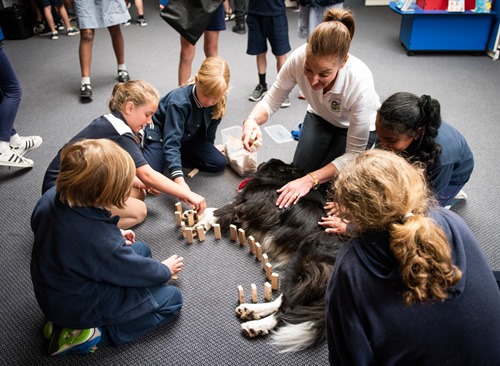
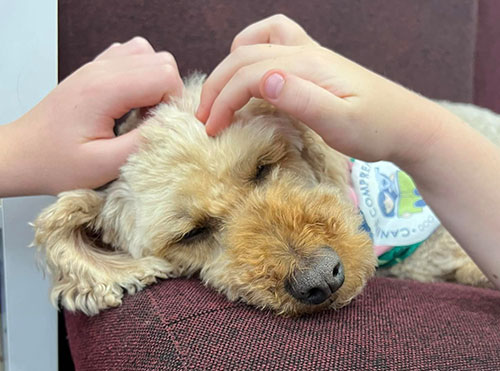
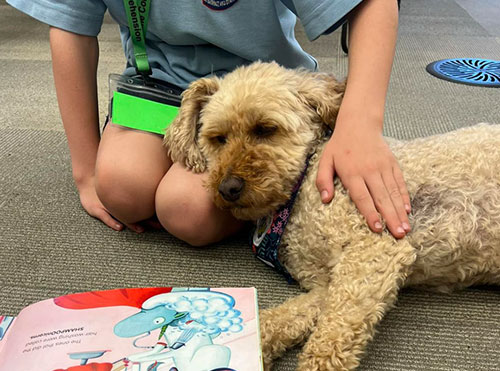
When people picture a therapy dog working in a school, they often imagine the interaction between the dog and the young person: a student sitting beside a dog, a hand resting on soft fur, perhaps a conversation becoming easier because there is a dog in the room.
What is less visible is everything happening at the other end of the lead.
Professional animal-assisted work relies on a skilled handler who understands their dog, communicates clearly and recognises that the dog’s behaviour is being shaped by every interaction around them. Training isn’t simply something completed before a therapy dog starts working. It is part of an ongoing partnership between dog and mentor.
Dogs are always learning – including at school
One of the most useful principles in our training with Dogmanship Training is deceptively simple: pay attention to what happens after a dog’s behaviour.
Rewards aren’t limited to treats. Food, toys, play and praise can all reinforce behaviour, and different dogs value these things differently. But everyday interactions can be rewarding too.
Imagine a therapy dog sees a student and pulls towards them. The student is delighted and immediately begins patting the dog. Nobody deliberately decided to reward pulling, but from the dog’s perspective the sequence may have been very clear: pull towards student → get access to student. Similarly, a dog that jumps up and receives laughter, attention and affection may be learning that jumping is an effective way of engaging people.
This matters in schools because therapy dogs work in socially rich and sometimes unpredictable environments. Students move, doors open, food appears, balls roll past and excited young people understandably want to interact with the dog. Good mentors need to recognise these moments as part of the dog’s ongoing learning, rather than assuming training stops when the school session begins.
Rewarding behaviour without bribing it
There is also an important difference between rewarding a dog and needing to show the dog a reward before they will respond.
In our Dogmanship training, mentors learn to work towards a pattern where the dog performs a known behaviour and reinforcement follows. Food can certainly be useful as a lure when initially teaching some behaviours, but we don’t want the sight of food to become necessary before a familiar cue has meaning.
That distinction becomes practical very quickly in a school.
If a door suddenly opens, a mentor may need their dog to wait. If a student approaches unexpectedly, the mentor may need their dog to remain with them. At other times, the dog may need to settle quietly while the mentor concentrates on supporting a young person. These behaviours need to become functional and reliable rather than dependent on a visible treat.
As behaviours become established, rewards can also become more varied. Praise, interaction, food, toys or play may all have a place, depending on the dog and the situation. The important professional skill is understanding what the individual dog finds rewarding and what behaviour is actually being reinforced.
Training and welfare must remain connected
There is an equally important caution here. A dog performing a behaviour does not automatically tell us how that dog is feeling.
Food itself can affect dogs differently. Some become more excited or focused around it; others may become frustrated or find it harder to settle. A dog might also refuse food when worried or overwhelmed. Neither accepting nor refusing a treat, by itself, is enough to tell us that a dog is comfortable or distressed. We need to look at the whole dog, the context and what is normal for that individual.
This is why training cannot be separated from understanding canine body language.
In animal-assisted work, the dog is a sentient participant, not a piece of therapeutic equipment. A mentor needs to notice when their dog is relaxed and engaged, but also when they are becoming tired, uncertain, over-aroused or uncomfortable. Sometimes good handling means reinforcing a behaviour. Sometimes it means reducing the difficulty of what we are asking. And sometimes it means advocating for the dog and ending an interaction altogether.
The same principle applies to young people. A trauma-aware, neurodiversity-affirming approach recognises that behaviour communicates information and that individuals respond differently to their environments. We shouldn’t assume that every child wants to interact with a dog, just as we shouldn’t assume that every dog wants every interaction with a child.
Professional practice happens at both ends of the lead
The presence of a dog alone does not make an activity a high-quality Animal-Assisted Intervention, and we should be careful not to overstate what dogs can achieve simply by being present.
The quality of the practice around that dog matters.
For Canine Comprehension, that means mentors who understand learning and reinforcement, develop reliable handling skills, continually observe their dogs and carefully manage interactions between dogs and young people. Our training is ultimately not about producing dogs that can perform a collection of obedience exercises. It is about developing skilled human–dog teams in which the mentor understands how their own decisions influence their dog’s behaviour.
That is the standard we want to see in schools: child-safe, evidence-informed and wellbeing-led practice where the needs of the young person matter deeply, and the welfare and agency of the dog beside them matter too.