Connection Is the Most Important Lesson We Teach.
What a school visit reminded us about belonging, behaviour and the extraordinary work happening in classrooms every day.
By Sarah Macdonald | Canine Comprehension
When you’re running an organisation, you can get so caught up in keeping everything moving that you forget to stop and appreciate what’s actually happening. The rosters, budgets, meetings and planning are all important, of course, but they’re not why we do this work.
This week, our Head of People and Culture, Alison, visited one of our partner schools to spend time watching our mentors and their dogs in action. On her way home, she sent me a message saying how much she loved her job. Naturally, I wanted to know why.
What followed was a conversation that reminded me of something I’ve believed for a very long time. Sometimes, connection needs to come before learning, and sometimes, connection is the learning.
When a Student Becomes the Teacher
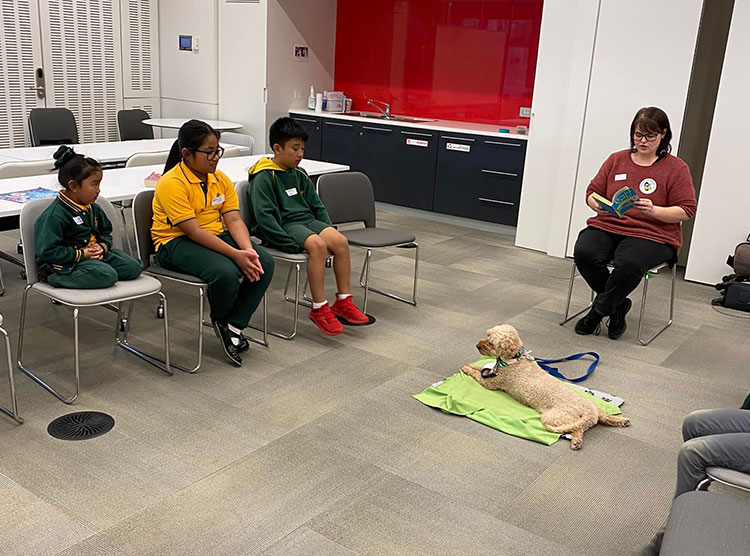
Alison had spent the day watching our mentor Lulu and her dog Ava delivering our Dog for a Day program. In one session, three young boys were sitting together on the classroom floor. One of them knew Ava particularly well. He’d been working with her for some time and was absolutely delighted to see her arrive. He wanted to spend every possible moment with her, and who could blame him?
But what Alison witnessed wasn’t simply a child enjoying time with a dog. It was a child learning to manage his own excitement so that two other students could share the experience. He showed them where Ava liked to be patted, explained how to offer treats safely, shared the ball and made sure everyone had an opportunity to participate. Without necessarily realising it, he had become the teacher.
I found this particularly lovely because sharing, waiting, managing impulses and including others can be genuinely difficult skills for some young people. These are the very skills that influence friendships, playground experiences and a child’s sense of belonging. When children struggle with these things, they can sometimes find themselves excluded, not necessarily because other children are being deliberately unkind, but because friendships involve an enormous amount of social negotiation.
Here was a young person practising those skills in a setting where he felt motivated, comfortable and connected. He wasn’t sharing because someone had told him he had to. He was sharing because including the other children in his relationship with Ava had become meaningful to him.
And that’s an important distinction. When we create opportunities for children to practise social and emotional skills through experiences they genuinely care about, we give those lessons a context that makes sense to them.
From Fear to Confidence
The second session Alison observed was very different. This time, Lulu and Ava were working individually with a student who had previously experienced an intense fear of dogs. At one point, that fear had been so overwhelming that when a dog barked across the road during a family walk, the child ran away and became lost. Imagine how frightening that must have been for everyone involved, and how an experience like that might change the way a family approaches something as ordinary as going for a walk.
Instead of enjoying time together, everyone may find themselves watching for dogs, anticipating barking and worrying about what might happen. Something that should be a simple pleasure can become an experience filled with anxiety.
Over time, with the support of his school, Lulu and Ava, this young person has been gradually developing confidence around dogs. Alison watched him sitting close to Ava, feeding her from a spoon and gently patting her. These might sound like small achievements, but when you understand where he started, they represent a significant change.
The story that really stayed with me, however, happened outside school. His mother recently told Lulu that they’d been trick-or-treating when they approached a house where a dog was barking. Previously, she would have expected her son to run, but this time he stayed and explained the barking in a way that felt less frightening to him. His mother was amazed.
I think it’s worth considering what that moment might mean for this family. Helping a child feel more comfortable around dogs isn’t simply about being able to pat one. It can influence their confidence in public spaces, their willingness to participate in family activities and the freedom everyone feels to enjoy ordinary experiences together.
Of course, we can’t attribute every change to one program or one relationship. Children develop through many experiences and with the support of many people. But stories like this help us understand why patient, consistent work matters and why progress isn’t always best measured by what happens during a single session.
Why More Students Doesn’t Always Mean More Impact
Something else Alison shared really interested me. This school has been working with Canine Comprehension for several years, and its approach to our programs has evolved considerably. In the beginning, there was an understandable focus on numbers. How many students could participate? How many children could benefit from having the dogs at school?
When budgets are tight and student needs are high, schools naturally want to make every dollar count. But over time, the staff noticed that larger groups weren’t necessarily delivering the best experiences for every student. The group dynamics could become overwhelming, some students needed more individual attention, and others benefited enormously from working in carefully selected small groups.
Rather than continuing to focus on how many students could fit into a session, the school began considering what each young person actually needed. Would they benefit from being part of a group? Would two or three students work better together? Would an individual session provide a more meaningful opportunity to develop confidence and practise new skills?
I love it when schools reach this understanding because it reflects something we see repeatedly in our work. Connection takes time, trust takes time, and the skills we want children to develop aren’t always learned most effectively in the biggest possible group.
There is a difference between providing access to an experience and creating the conditions for meaningful participation. Both matter, but they aren’t necessarily the same thing. Sometimes, reaching fewer students at one time allows us to give those young people the attention and support they need to make genuine progress.
Behaviour Is Communication
One final story from Alison’s visit particularly stayed with me. The school had been supporting a young student who was displaying physical aggression towards other children. Understandably, staff were concerned about safety and had considered removing her from the dog program. The thinking was that participation was something she enjoyed, and they didn’t want it to become a reward following unsafe behaviour.
I understand that reasoning, but Lulu saw another possibility. What if the program wasn’t simply something the student enjoyed? What if it was also an opportunity to teach some of the skills she was struggling with?
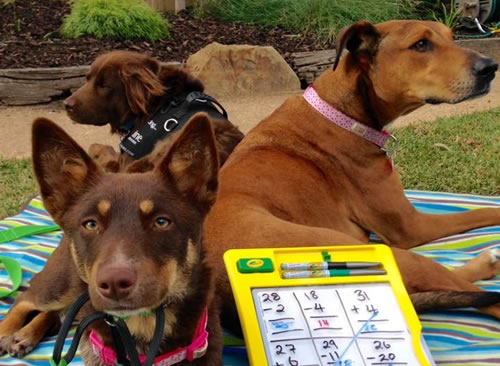
Rather than immediately removing that opportunity, Lulu began working with the school on a different approach. Using photographs of Ava and another Canine Comprehension dog, Harmony, they began exploring differences. Dogs look different from one another, just as people do, but regardless of appearance, everyone deserves to be treated with care and respect.
The idea was to use the student’s existing interest in the dogs to open conversations about feelings, gentleness, difference and how we treat others. It’s still a work in progress, and we don’t yet know what the longer-term outcomes will be, but I love the thinking behind it.
I’ve always believed that behaviour is communication. That doesn’t mean every behaviour is acceptable or that we shouldn’t set boundaries. Of course we should. Children need safety, consistency and clear expectations. But when we look beyond the behaviour itself and become curious about what a child understands, feels or needs, we create more opportunities to teach.
Sometimes, the behaviour we’re trying to change is also telling us something important about the skills a child hasn’t yet developed. Removing a positive experience may be necessary in some circumstances, particularly where safety is concerned, but it isn’t always the most useful response. There can be enormous value in asking how we might use that experience to help the child learn a different way of interacting with the world.
The People Who Keep Finding a Way
There was another part of Alison’s visit that wasn’t quite so uplifting. The school shared concerns about disability inclusion funding for a student who continues to need significant support throughout the school day. Despite those needs, the school had lost access to funding it had previously received.
I don’t know all the circumstances behind that decision, and funding assessments are often more complicated than they first appear. But what struck me was the response from the school. The principal and staff weren’t simply accepting that the child’s needs had disappeared because the funding had changed. They were looking for other ways to continue providing support, including considering community fundraising and approaching organisations such as Rotary.
It made me think about how often educators are asked to do exactly that. Find another way, stretch the budget, make the resources go further and support the child anyway.
We work with many schools facing significant challenges, so I recognise that our experiences don’t necessarily represent every school. But we do see the extraordinary lengths some educators go to when they believe a young person needs more support than the available resources can provide.
While that dedication deserves recognition, it also raises an important question about how sustainable it is to continually expect educators to do more with less. The consequences don’t stop with the students. They affect the teachers, education support staff and school leaders who want to make a difference but don’t always have the resources they need.
I think sometimes we forget that the adults in our schools need to feel supported, valued and capable of making a difference too. It’s difficult to create a calm, connected learning environment when the people responsible for providing it are themselves stretched beyond capacity.
What the Dogs Remind Us
When Alison and I finished talking, I found myself feeling incredibly grateful. Grateful for our mentors, who bring patience, creativity and care into schools every week. Grateful for the teachers and support staff who work alongside them, and for the principals who recognise that belonging and wellbeing are part of creating the conditions for learning.
Most of all, I felt grateful for the young people who continue to surprise us with what they’re capable of when we give them time, encouragement and opportunities to connect.
I sometimes think we underestimate the complexity of what children are learning when they interact with a dog. They’re reading body language, recognising emotions, practising boundaries, managing excitement, learning patience, taking turns and considering someone else’s needs. These aren’t small lessons. They’re life lessons, and they’re the skills that help young people develop friendships, participate in their communities and feel that they belong.
While the dogs provide a wonderful reason to begin, it’s the relationships between the students, mentors and educators that make the experience meaningful. The dogs help create opportunities for connection, but it’s what we do with those opportunities that matters.
At Canine Comprehension, our purpose is to help young people feel connected, calm and ready to learn. Some days, that looks like a child confidently reading aloud. Some days, it’s a student learning to share a ball. And some days, it’s a family being able to walk past a barking dog without the same fear they once experienced.
Not every achievement can be neatly captured in a spreadsheet, although I believe we should continue finding thoughtful ways to evaluate the work we do. Stories and observations help us understand the human experience behind the numbers, while good evaluation helps us establish whether the changes we’re seeing are consistent and meaningful.
What Alison brought back from her school visit was a reminder of why this work matters, and why it’s so important that we continue listening to the people delivering it and the educators working alongside them.
Sometimes, the most meaningful progress begins with a relationship. And sometimes, it begins with a dog.
Bringing Connection Into Your School
At Canine Comprehension, our mentors and their dogs work alongside educators to create opportunities for students to practise social, emotional and communication skills through meaningful, supported experiences.
Our Dog for a Day visits can be tailored to different student needs, from carefully selected small groups to individual experiences where appropriate. Because meaningful engagement isn’t always about reaching the greatest number of students. It’s about creating the right opportunity for the young person in front of us.
Explore our school programs at caninecomprehension.com.au.