Trauma-informed practice is more than a value. It is a way of working.
At a recent conference, I sat in on a presentation about trauma-informed practice that left me reflecting honestly on our own work. Not because the ideas were unfamiliar, but because the session highlighted just how much sits underneath the phrase “trauma-informed”. It is easy to say we care deeply about young people. It is harder, and more important, to ask whether our systems, environments, decisions and day-to-day practices consistently reflect that care.
The presentation referenced the review by Sarah Bendall, Oliver Eastwood, Georgina Cox, Anna Farrelly-Rosch, Helen Nicoll, Wilma Peters, Alan P. Bailey, Patrick D. McGorry and Faye Scanlan, “A Systematic Review and Synthesis of Trauma-Informed Care Within Outpatient and Counseling Health Settings for Young People”. The review examined thousands of records and identified 10 components that commonly appear when trauma-informed care is put into practice. These included system-level elements such as leadership, governance, safety, staff training, interagency collaboration, cultural and gender sensitivity, and genuine participation from young people and families or carers. It also included clinical practices such as **screening and assessment, psychoeducation, and therapeutic interventions.
What is Trauma-Informed Practice?
What stood out to me is that trauma-informed practice is not a single strategy, a training session, or a set of good intentions. It is organisational. It asks whether young people and families have a real voice in shaping care. It asks whether physical and psychological safety have been designed into the environment. It asks whether staff at every level understand trauma and respond in ways that reduce the risk of retraumatisation. It asks whether leadership is actively driving the work, not just endorsing it from a distance.
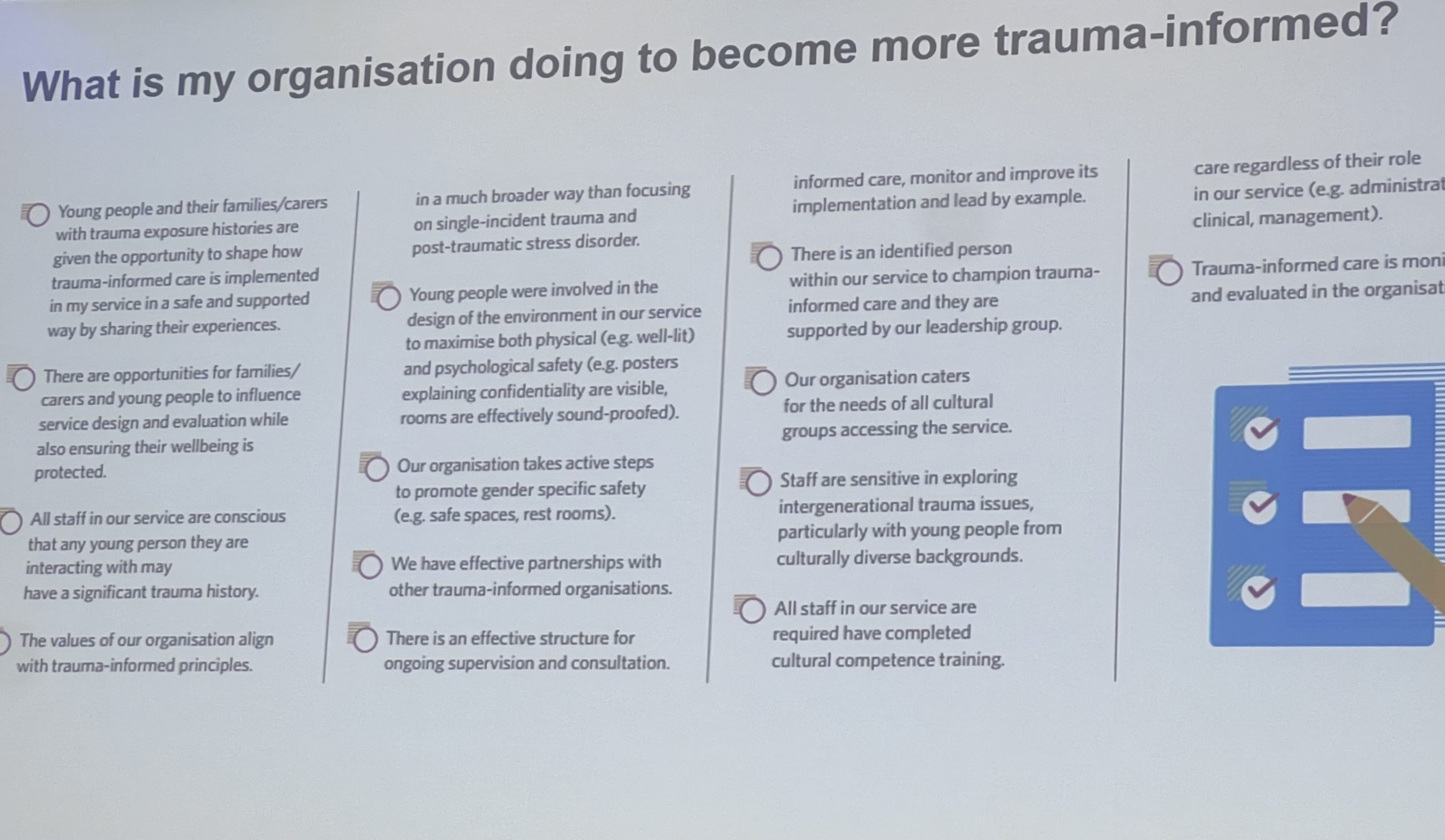
One of the conference slides asked a confronting but necessary question: What is my organisation doing to become more trauma-informed? That question landed. Because if I answer it honestly, I think we still have a long way to go. We care deeply. We want to do right by the young people and families we work alongside. But wanting to be trauma-informed is not the same as being trauma-informed in a consistent, embedded and measurable way.
Another useful lens shared in the presentation was the EPIS framework: Exploration, Preparation, Implementation and Sustainment. I found this especially helpful because it frames trauma-informed practice as a process, not a finish line. First, an organisation explores what is needed and what evidence-based approach fits. Then it prepares by identifying barriers, building readiness, planning and training staff. Next comes implementation, where practice is introduced, monitored and adjusted in real-world conditions. Finally, sustainment asks whether the work becomes part of the organisation itself through ongoing quality assurance, leadership support and stable resourcing.
That matters because many organisations, including ours, may be strong in values and intention but earlier in implementation than we would like to admit. We may already do some things well. We may build trusting relationships, respond with empathy and work hard to create safe experiences for young people. But trauma-informed practice asks for more than isolated strengths. It asks for alignment across leadership, policy, environment, staff capability, partnerships and review processes.
For me, the biggest takeaway from this session was not guilt. It was clarity. If we believe relationships matter, if we know many young people carry experiences of trauma, and if we want our work to support healing rather than harm, then we need to keep building our practice with intention. That means asking harder questions of ourselves. It means listening more closely to young people and families. It means reviewing not only how we interact, but how our organisation functions.
Trauma-informed practice is not about getting everything perfect. It is about being willing to look honestly at where we are, where the gaps are, and what needs to change. That is the work. And for organisations that support children and young people, it is work worth doing.
References
Bendall, S., Eastwood, O., Cox, G., Farrelly-Rosch, A., Nicoll, H., Peters, W., Bailey, A. P., McGorry, P. D., & Scanlan, F. (2020). A systematic review and synthesis of trauma-informed care within outpatient and counseling health settings for young people. Child Maltreatment, 26(3).
Moullin, J. C., Dickson, K. S., Stadnick, N. A., Rabin, B., Aarons, G. A. (2019). Systematic review of the Exploration, Preparation, Implementation, Sustainment (EPIS) framework. Implementation Science, 14(1).